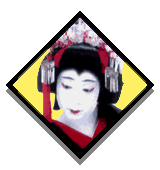

Kabuki
is a traditional form of Japanese theater. It was founded early in the 17th
century by Okuni, a shrine maiden who brought her unique and lively dance
style to the dry river beds of the ancient capital of Kyoto, and over the next
300 years developed into a sophisticated, highly stylized form of theater.
Though Kabuki was created by a woman, since early on all roles have been
taken by men. Men who play the roles of women are referred to as "onnagata"
female role specialists. Ichimura
Manjiro , an actor who actively participates in this page, is an
"onnagata".
Kabuki plays and dances may be about grand historical events or the everyday
life of people in the Edo period (1600-1868). For each play, though, the sets,
music, costumes and other factors combine to create the fantastic world of
Kabuki. We hope you enjoy exploring this page.
 |
The shamisen is the most important
instrument in Kabuki.
Imported to Japan around the same time Kabuki was created, it became the
main instrument for all schools of music started in the Edo period. Here
Manjiro plays a short passage often used in dances that feature
characters of great strength. |
 |
The tsuzumi is the central instrument around which the
percussion ensemble is formed. Its distinctive "pon" is a
symbol for traditional Japanese culture as a whole |
 |
The Odaiko drum is used to create various sound effects,
such as the sound of rain or the wind. The fast beats used here
symbolize the appearance of a ghost. Note how the eerie sound of the
flute adds to the effect. |
 |
The Okawa side drum has a sharp, distinctive sound that
sets it apart from the other drums with softer skins. |
 |
Usually the first sound one hears when one enters the
theater is the shime daiko drum, which is used to signal the beginning
and end of a performance. |
|
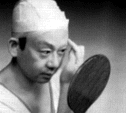 |
First, wax is applied to the eyebrows and
oil is spread on the areas where make-up is to be applied to help
the make-up stick. |
|
|
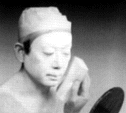 |
Oshiroi, or white face cream, is
applied as a base. The shade of white depends on the role to
be played: young or old, princess or commoner, or any other
number of factors |
|
|
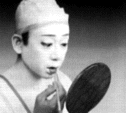 |
Mehari, or red lines, are
added to accent the eyes, and eyebrows are drawn in.
The eyebrows are one of the most important aspects
of expressing the role to be played. A small amount
of lipstick is applied to further express the
characteristics of the role. |
|
|
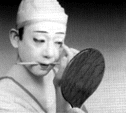 |
Make-up is applied
not only to create a pretty face, but is
also a way for the actor to get into
character. It provides a chance for the
actor to actually become his role. |
|
|
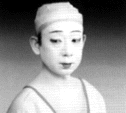 |
Finished. |
|
|
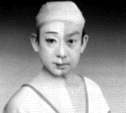 |
Make-up provides
an outer expression of the
heart. |
|
Thanks to this web site:

 Home
Home  Next
Next